
By Patrick O’Neill, PJO Insurance Brokerage. Reviewed for accuracy against Nevada Revised Statutes Chapters 683A and 685A.
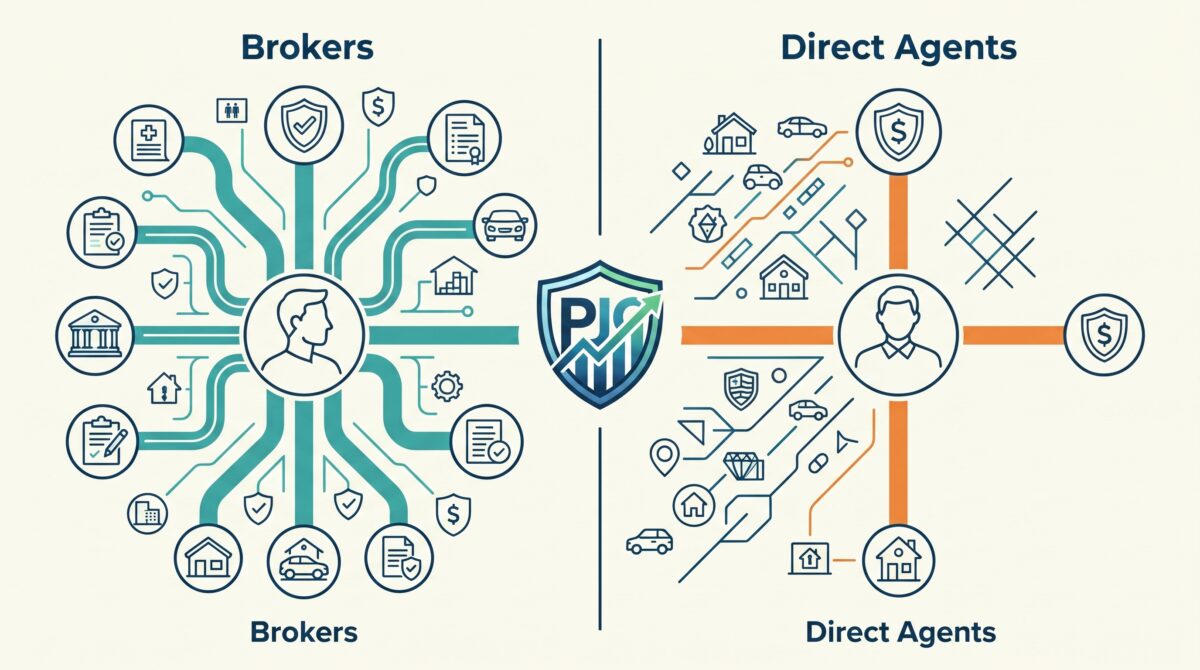
If a friend tells you to call their insurance guy, it helps to know which kind of insurance guy they meant. Nevada law sorts every licensed producer into one of two roles on any given policy, and that role decides who pays them, whose side they are on, and whether they can put coverage in force for you at all.
Here is the quick version:
- A direct agent (often called a captive agent) represents one insurance company and sells that company’s products.
- An independent agent is appointed by several carriers and can quote your risk across all of them.
- A broker is not appointed by the carrier. Under NRS 683A.321, a broker works on behalf of the buyer and cannot obligate an insurer through their own actions.
- The same licensed person can act as an agent for some carriers and a broker for others, so the label describes the transaction, not the business card.
- Agents are paid a commission by the insurer. A producer who is not appointed cannot accept that commission, which is why broker compensation usually comes from you instead.
- For most Las Vegas small businesses, an independent agent is the practical default. Brokers earn their keep on risks that are hard to place.
Exploring The Functions Of Independent Agents & Brokers In Insurance
Friends or family may recommend their independent insurance agent or an insurance broker, and the two words get used as if they mean the same thing. They do not. In Nevada the difference is written into statute, and it changes what the person across the table is allowed to do for you.
An independent agent works something like a personal shopper. They get to know your operation, then bring back options from the carriers they represent. A broker sits one step further from the carriers and shops the wider market on your behalf, including places an appointed agent cannot reach.
Both are licensed producers. Both answer to the Nevada Division of Insurance. The split happens at appointment, which is the paperwork a carrier files to authorize someone to act as its agent.
What Are Independent Insurance Agents?
An independent insurance agent is a local insurance professional who gets to know you and your needs before recommending coverage. They are not tied to a single insurance provider. They hold appointments with several carriers, which lets them offer real choices instead of one company’s answer to every question.
That appointment is the part that matters. Under NRS 683A.321, a producer cannot act as an agent unless the insurer has appointed them, and the insurer files that notice of appointment with the Commissioner. Once appointed, the agent can bind coverage for that carrier. Binding is what puts your policy in force, and it is the difference between “we sent in your application” and “you are covered as of this morning.”
If you carry several policies, this is usually the faster route. One person who holds multiple appointments can quote your general liability, your property, and your workers’ compensation in one pass, then put them in force without a middle step.
What Is A Direct Agent?
A direct agent, usually called a captive agent, holds an appointment with one insurer and sells that company’s products. In the legal sense they are an agent exactly as NRS 683A.321 describes: appointed by the insurer, compensated by the insurer, and able to bind coverage.
The difference between a direct agent and an independent agent is not the license they hold. It is the number of appointments behind it. One carrier versus several.
That single number decides how the conversation goes. If their company wants your class of business, a direct agent is quick, and they will know that carrier’s forms better than anyone. If their company does not want your risk, there is no second option to try, and the conversation ends there.
So What Is An Insurance Broker?
Insurance brokers sell and sometimes negotiate all types of coverage, including property, casualty, specialty, and health lines, for individuals and companies alike. They discuss your needs and bring back multiple options. Many brokerage firms will let you compare quotes side by side from several companies.
The statutory definition is narrower than the everyday one. NRS 683A.321 defines a broker as a producer who is not an agent of an insurer, who solicits or procures insurance on behalf of an insured, and who “does not have the power, by his or her own actions as a broker, to obligate an insurer upon any risk.”
A broker can find you the coverage and hand the carrier your application. A broker cannot flip the switch that makes it real. That is what “obligate an insurer” means in the statute, and it is the practical difference between the two roles.
Nevada adds one more rule that surprises people. For property and casualty risks located in this state, a broker cannot place the coverage except through a licensed agent of an authorized insurer. Life insurance, health insurance, annuities, and surplus lines business written under the Nonadmitted Insurance Law sit outside that restriction.
That exception is where a lot of hard commercial risk actually gets placed. Surplus lines carriers, also called nonadmitted carriers, are insurers that Nevada has not licensed but that are permitted to write business the standard market turns down. Reaching them takes a separate surplus lines broker license. Under NRS 685A.150 a licensed surplus lines broker may accept that business from any producer licensed in Nevada and pay them for it, which is how your existing agent can get a declined risk placed without you starting over somewhere new.
What happens if every standard carrier declines my business?
You move to the surplus lines market, and you need someone with a surplus lines broker license to get there. That is the point where the distinction in this article stops being academic. A direct agent whose carrier has declined you has run out of options. An independent agent can try their other appointments first, then hand the risk to a surplus lines broker. Ask whether the person quoting you holds that license or works with someone who does.
“PJO Insurance was able to provide product liability insurance when no one else could, even the company I was insured with for several years.”
Sherrel Heath, reviewed on Google, October 2025
Does a broker mean my coverage takes longer to start?
It can. Because a broker cannot bind coverage, a Nevada commercial policy placed through a broker still has to reach a licensed agent of an authorized insurer before it goes in force. On a straightforward risk that step adds time you would not spend with an appointed agent. On a hard-to-place risk it is time well spent, because the broker is reaching markets the agent cannot. Ask up front who will be binding the policy and on what date.
Independent Insurance Agents vs. Brokers: Key Differences You Need To Know
Two legal roles, three kinds of professional. Nevada statute recognizes only agent and broker, but the market sorts agents into two very different kinds depending on how many carriers appointed them. That is why the comparison below has three columns and the statute has two.
| How they differ | Direct (Captive) Agent | Independent Agent | Broker |
|---|---|---|---|
| Who they represent | One insurer | Several insurers | The buyer |
| Carrier appointment | Yes, with one | Yes, with many | No |
| Can bind coverage | Yes | Yes | No, not on their own |
| Who pays them | The insurer | The insurer | Usually the client |
| Market reach | Narrow | Broad | Broadest, including surplus lines |
A direct agent is the one whose office carries a single company’s name on the door. One appointment, one set of forms, one answer.
An independent agent holds appointments with a range of carriers and gives you real insight into how each one handles a claim, what they are competitive on, and where they get twitchy about a risk. That accumulated knowledge of carrier behavior is the part you cannot get from a quoting website.
A broker can search anywhere, but will not know any single carrier’s habits as deeply. Brokers are the answer when the risk is awkward: a business with a heavy loss history, an operation handling hazardous materials, an unconventional venue, or a large multi-state exposure. Independent agents handle most of the rest.
One point almost everyone gets wrong: these are not three different careers. NRS 683A.321 says a producer acting as an agent may also act as a broker for insurers that have not appointed them. The same person can be your agent on a package policy and your broker on the odd exposure the package will not touch. Ask which hat they are wearing on your policy.
Which Is More Affordable? An Insurance Broker Or An Independent Agent?
The premium is set by the carrier and the risk, not by the title of the person selling it. Where the two roles differ is in how the person gets paid, and Nevada statute is specific about it.
An agent is defined as a producer who is compensated by the insurer. NRS 683A.361 goes further: a producer cannot accept a commission from an insurer unless that insurer has appointed them as an agent. So a broker who holds no appointment is generally cut off from carrier commission on that placement, and the compensation has to come from somewhere else. In practice that means a fee you pay.
That is the mechanism behind the common observation that brokers cost more. It is not a markup on the policy. It is a separate fee for a separate service, and on a risk three carriers have already declined, that fee often buys coverage you were not otherwise going to get.
In the surplus lines market that fee has a ceiling written into statute. Under NRS 685A.155 the surplus lines broker first engaged on your placement may charge a fee for procuring the coverage, but that fee plus any other commissions and charges payable to that broker cannot exceed 20 percent of the premium you pay, unless the insurer and the broker have agreed otherwise. If you are being quoted a surplus lines placement, that is the number to ask about.
How do I find out what I am actually paying the person, not the carrier?
Ask directly, and ask for it in writing before you sign anything. The question that gets a clear answer is: “Are you appointed with this carrier, and are you being paid by them or by me on this policy?” Any producer worth hiring will answer it in one sentence. Get any separate service fee, its amount, and what it covers stated in writing on the proposal, so it does not turn up on an invoice later.
Should I Use A Broker Or An Independent Agent?
This depends on your risk, not on your preference. Three questions sort most Nevada businesses.
First: has anyone declined to quote you? If carriers are competing for your business, an independent agent will get you there faster and without a separate fee. If you have been declined, non-renewed, or told your class of business is not eligible, that is broker territory. Reaching surplus lines markets is exactly the job.
Second: how unusual is your exposure? A contractor, a restaurant, a child care center, or a startup with an ordinary loss history is well served by an appointed agent. Look at the Las Vegas contractors insurance and start-up business insurance pages for what standard placements cover. If your operation involves pollution exposure, professional liability layered over an unusual service, or a claims history that needs explaining, you want someone who can shop outside the admitted market.
Third: what happens at renewal? This is where appointments do the most work. A direct agent can only re-quote you with the one carrier that appointed them, so a bad renewal leaves you two options, accept it or change firms. An independent agent holding several appointments can move you between carriers without you changing firms at all. A broker can go further and test the nonadmitted market. If your premium has jumped two years running, ask which of those three a renewal review at that firm would actually involve.
For personal lines the answer is usually simple. If you are buying homeowners or life coverage, an independent agent can start and finish the process for you. Businesses are where it gets harder, and the trigger is the nature of the risk rather than the size of the company. A large payroll on its own is ordinary business that plenty of carriers want. Three things do send you looking for a broker: a payroll spread across several states, an operation with a claims history that needs explaining, or a class of business that carriers have started avoiding. Coverages like directors and officers liability and employment practices liability reward that extra market access.
Can one firm do both?
Yes, and in Nevada that is common. Because a producer may act as an agent for carriers that appointed them and as a broker for carriers that did not, one office can place your standard coverage as an agent and go to the surplus lines market as a broker for the one exposure that does not fit. You do not have to choose a category and live inside it. You have to know which role applies to which policy on your schedule.
What To Ask Before You Sign
Six questions, and you can ask them in a single phone call:
- Are you appointed with the carrier you are quoting me, or are you acting as a broker on this placement?
- Who binds this policy, and what is the effective date?
- Are you paid by the carrier, by me, or both on this one?
- How many carriers did you approach, and which ones declined?
- When my policy renews, who reviews it, and do you re-shop it or roll it?
- Are you and your agency licensed in Nevada right now, and what name is the license held under?
Question four is the one that separates a real market search from a single quote dressed up as a comparison. Question five is where most businesses quietly lose money, because a policy that rolls untouched for six years drifts away from what the operation actually looks like now.
Question six takes a minute and almost nobody asks it. The Nevada Division of Insurance licenses every producer and agency doing insurance business in the state and can confirm whether a license is active. Ask for the exact name the license sits under, because producers often trade under an agency name that is not their own.
If you are still working out which coverages belong on the schedule at all, the frequently asked questions page covers the ground-level items, and the full list of coverages shows what a complete program tends to include.
Choosing The Right Insurance Professional For Your Needs
Now that the three roles are clear, the choice comes down to your own situation. If you need to protect property or a family, an independent agent is usually the direct route. If your risk has been turned down, or it sits outside what standard carriers want, a broker is worth the fee. Plenty of businesses end up using both, which Nevada law expressly permits.
At PJO Insurance Brokerage we work from the client’s side of the table: understanding your concerns, researching what your operation actually needs, and building a plan around it rather than around a product sheet. If you want a second read on a policy you already have, that is a fine place to start. Bring the declarations page and we will tell you what it does and does not do.
“Patrick at PJO Insurance has been more than helpful and has helped me tremendously with my business! He is always there to help and quick to respond. He is knowledgeable in all aspects of Construction from General Liability to Workman’s Comp questions. I truly appreciate all the help he has given me over the years!”
Karen Campbell, reviewed on Google
Contact our Nevada office for a plan built around your specific exposure, or read more about how we work before you call. Our Las Vegas business insurance page lays out the coverages we place most often in the valley. Related reading: how to file a workers’ compensation claim in Nevada and what property damage commercial insurance covers.
PJO INSURANCE BROKERAGE
Email: patrick@pjobrokerage.com
Website: www.pjobrokerage.com
Nevada Location
9850 S Maryland Parkway Suite A-5-262
Las Vegas, Nevada 89183
Office: 702-747-5403
Arizona Location
4103 East Prickly Pear Trail
Phoenix, Arizona 85050
Office: 480-680-9951
California Location
107 Via Estrada, Unit A
Laguna Woods, California 92637
Office: 949-264-0889
This article is general information about how insurance producers are licensed and compensated in Nevada. It is not insurance advice for your specific situation, and it is not a statement of coverage. Statutory references are to Nevada Revised Statutes Chapters 683A and 685A. Licensing status can be confirmed through the Nevada Division of Insurance. Talk to a licensed producer about your own risk before making a decision.